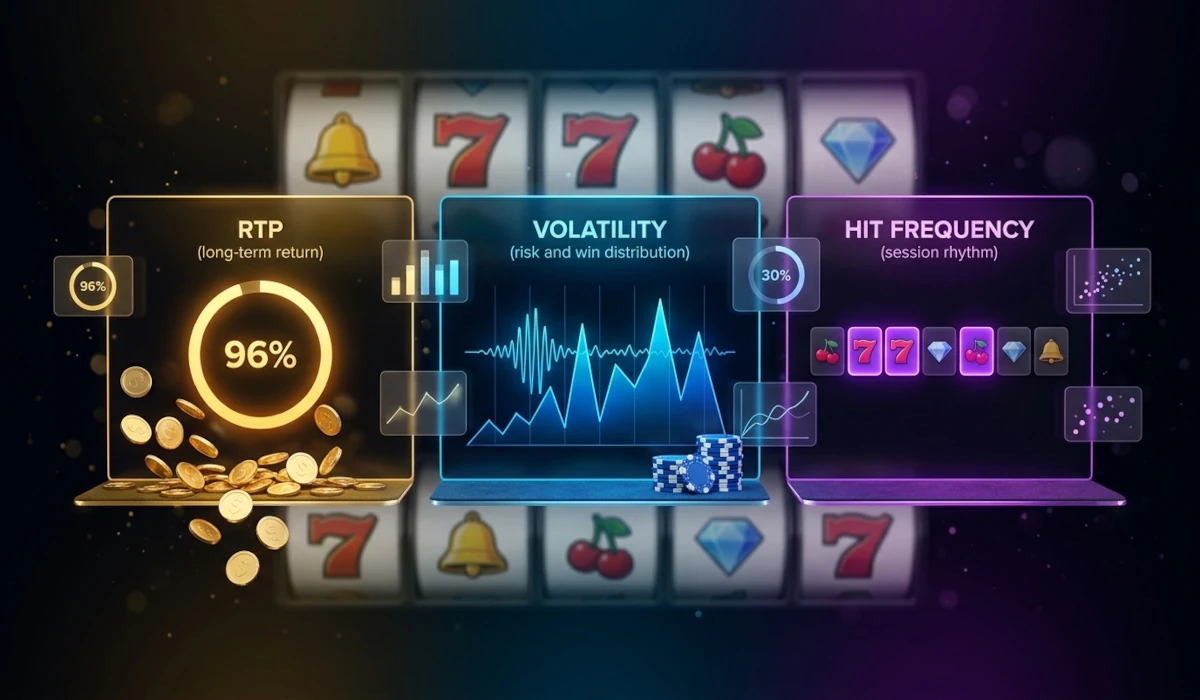

Hit Frequency vs RTP vs Volatility: The Three Metrics Compared
🗝️ Key Takeaways
- RTP, volatility, and hit frequency are the three core slot metrics, and each measures something completely different: RTP describes long-term return, volatility describes the size-and-frequency distribution of wins, and hit frequency describes how often any win lands.
- Two slots with identical RTP can feel like completely different games when their volatility and hit frequency profiles differ, because RTP only tells you what comes back on average, not how that return arrives.
- Hit frequency and volatility are related but not the same: hit frequency only counts how often wins happen, while volatility also factors in the size of those wins, which is why high-volatility slots can have both low and moderate hit frequencies.
- Reading all three metrics together turns slot selection from guesswork into a calibrated decision, because the combination tells you exactly what kind of session you're signing up for before the first spin.
- Operators can only change RTP variants (and only where licensing allows), so volatility and hit frequency are properties of the game itself and are usually fixed, although casinos can choose between RTP versions.
Most players pick slots based on theme, graphics, or what a friend recommended. The more experienced players pick based on RTP.
The small group who actually understand what they're doing pick based on all three core metrics at once, because each metric answers a completely different question about what the slot will do with your bankroll. This guide breaks down how RTP, volatility, and hit frequency relate to each other, where they overlap, where they diverge, and how to read them together when choosing a slot.
The goal is simple: by the end, you should be able to look at any slot's info panel, read the three numbers, and accurately predict what your session will feel like before you press spin.
📋 The Three Metrics at a Glance
Before diving into the interactions, it helps to have all three metrics visible in one place. The table below summarises what each one measures, how it's expressed, and what it tells you (and what it doesn't).
| Metric | What It Measures | Typical Values | Tells You | Doesn't Tell You |
| RTP | Long-term return percentage of total wagers | 92% to 99% (96% common) | Expected average return over hundreds of thousands of spins | How often you'll win or how big the wins are |
| Volatility | Distribution of win size and frequency | Low / Medium / High (or 1 to 5 scale) | The session rhythm and bankroll risk profile | The exact return percentage or exact hit rate |
| Hit Frequency | Percentage of spins producing any win | 15% to 40% (20-30% average) | How often any win lands, regardless of size | How big the wins are or total return over time |
The table is a quick reference. The rest of the guide explains how these metrics interact, where players confuse them, and how to use all three together when picking a slot.
💰 RTP: The Long-Term Return
RTP (Return to Player) is the theoretical long-term return percentage of a slot, expressed as the share of total wagers the game returns to players over time. A 96% RTP slot returns €96 for every €100 wagered across a statistically significant sample, which typically means hundreds of thousands or millions of spins.
RTP is calculated by running the game's mathematical model through simulations and measuring the total payouts as a percentage of total wagers. It's the only one of the three metrics that carries mandatory disclosure requirements in most regulated markets, which is why casinos display it prominently, and providers publish it consistently.
What RTP tells you is the expected average return over a long enough sample. What it doesn't tell you is how that return is distributed.
A slot can deliver its 96% RTP through thousands of small wins or through a handful of massive hits separated by long dry runs, and the RTP figure alone gives no indication of which pattern you'll experience. This is the single biggest misconception about RTP: it describes the destination, not the journey.
Our dedicated RTP guide covers the full mechanics, including the calculation formula, adjustable RTP configurations between casinos, and how to find the active RTP variant in any game info panel.
🎢 Volatility: The Win Distribution
Volatility (sometimes called variance) describes how a slot distributes its wins in terms of size and frequency. Low-volatility slots pay out small amounts often, medium-volatility slots sit in the middle, and high-volatility slots pay rarely but produce larger wins when they land.
Volatility is not a single calculated number like RTP. It's usually expressed as a classification (low, medium, high) or on a 1-to-5 scale, and providers assign the rating based on their internal variance metrics, including standard deviation of returns and the distribution of wins across the full payout schedule.
Some game providers publish numerical volatility scores alongside RTP, while others only give qualitative ratings. What volatility tells you is the session risk profile. A high-volatility slot can drain your bankroll quickly during dry runs but can also produce wins that dwarf anything a low-volatility slot can deliver.
A low-volatility slot keeps your bankroll stable with frequent small wins but caps the upside. What volatility doesn't tell you is the exact return percentage (that's RTP) or the exact hit rate (that's hit frequency), though it correlates with both.
Our volatility guide breaks down how to read volatility ratings and match them to your playing style.
🎯 Hit Frequency: The Session Rhythm
Hit frequency, also called hit rate, is the percentage of spins that produce any winning outcome regardless of size. A 25% hit frequency means roughly 1 in 4 spins will return some payout, which could be fractional, equal to the bet, or many multiples above it.
Hit frequency is calculated the same way as RTP, through simulation, but it counts the number of winning outcomes rather than the total payout. The industry average sits between 20% and 30%, with low-volatility slots often exceeding 30% and high-volatility slots typically falling below 20%.
What hit frequency tells you is the rhythm of the base game, whether wins arrive steadily or sporadically. What it doesn't tell you is how big those wins are (a slot can have 30% hit frequency where most hits pay less than the bet) or the long-term return (a high hit frequency slot can still have low RTP if the wins are mostly small).
Our hit frequency guide covers typical ranges, how to find the data, and why it alone can mislead.
🔄 How the Three Metrics Interact
This is where the comparison gets interesting. The three metrics are mathematically related but not interchangeable, and understanding the interactions is what separates informed players from casual ones.
⚖️ RTP and Volatility
RTP and volatility are independent properties. A slot can have high RTP and low volatility, high RTP and high volatility, low RTP and low volatility, or low RTP and high volatility.
Every combination exists in the market, and each produces a different session experience. What RTP and volatility together tell you is the balance between expected return and session risk.
A 97% RTP low-volatility slot is a slow, steady grind with good long-term value. A 94% RTP high-volatility slot is a gamble on big hits with lower average returns.
Most players naturally gravitate toward the higher-RTP low-volatility combination for session stability, while players chasing big wins accept lower RTP and higher volatility.
🌊 Volatility and Hit Frequency
Volatility and hit frequency correlate strongly, but are not the same thing. Low-volatility slots almost always have high hit frequencies because they pay often with small wins.
High-volatility slots almost always have low hit frequencies because they pay rarely. But the correlation is not perfect, and the edge cases are where it gets interesting.
Some high-volatility slots maintain moderate hit frequencies (around 20-25%) while concentrating variance into rare but massive hits. These slots feel like they pay often in the base game, but the real volatility shows up in bonus rounds where the big wins live.
Players who judge volatility purely by base-game rhythm often misread these titles and end up surprised by the swings. The key insight: hit frequency measures how often wins happen, while volatility measures the size distribution of those wins.
Two slots can have identical 25% hit frequencies but completely different volatility if one pays mostly small wins and the other pays a mix of small wins and occasional massive hits.
🔀 RTP and Hit Frequency
RTP and hit frequency are the most independent of the three pairings. A slot can have 96% RTP with 15% hit frequency (rare but significant wins) or 96% RTP with 35% hit frequency (frequent but mostly small wins).
Both return the same average over time, but the experience is completely different. This is why hit frequency alone is a poor slot-selection metric.
A game advertising 30% hit frequency could have a lower RTP than a game with 15% hit frequency, meaning you win more often but lose money faster because most of those frequent wins pay less than your stake.
🎲 Same RTP, Different Experience: Worked Example
The best way to understand how the three metrics interact is with a concrete example. Consider two slots, both advertising 96% RTP.
Slot A has low volatility and 35% hit frequency. Across a 500-spin session at €0.50 per spin, you place €250 in total wagers, and the slot pays back roughly €240 (96% RTP) distributed across roughly 175 winning spins, most returning between €0.20 and €1.50.
The session feels steady, with small wins arriving every few spins. The bankroll dips gently and occasionally recovers, and the emotional experience is calm.
Slot B has high volatility and 12% hit frequency. Across the same 500-spin session at the same stake, the same €250 is wagered.
The slot still pays back roughly €240 over a long enough sample, but the distribution is completely different. Most of that €240 comes from a small number of significant hits (perhaps 3 or 4 wins above €20), while the other 56 winning spins return small amounts.
The session feels harsh during dry runs, with 20 or 30 consecutive losing spins not unusual, punctuated by occasional bursts where a single spin returns €15, €25, or €40. Both slots deliver the same expected return.
The long-term mathematics are identical. But the session experiences are so different that a player who enjoys Slot A would often hate Slot B, and vice versa.
This is why advertising RTP alone is misleading. The figure tells you what the slot returns over time, but says nothing about how that return arrives, which is the part that actually shapes every minute of your session.
🧭 How to Read the Three Metrics Together
When evaluating a slot before a session, read the three metrics in this order to build a complete picture. First, check RTP to understand the baseline expected return.
A 96% RTP slot gives you better expected value than a 94% RTP slot of the same game type, regardless of how the two metrics are distributed. If the slot has multiple RTP variants, confirm which one is active at your casino.
Second, check volatility to understand the session risk profile. Low-volatility slots suit long sessions with small bankroll swings, while high-volatility slots suit short sessions with bigger stake tolerance and patience for dry runs.
Third, check hit frequency to understand the base-game rhythm. High hit frequency (above 30%) means wins arrive steadily and the bankroll depletes slowly.
Low hit frequency (below 20%) means long losing stretches punctuated by occasional wins. The combination determines the slot's full personality.
A 96% RTP, low-volatility, 35% hit frequency slot is a steady companion for long sessions. A 96% RTP, high-volatility, 12% hit frequency slot is a bankroll stress test with potential for theatrical wins.
Same RTP, totally different games.
🎯 Picking Slots for Different Goals
The three-metric framework becomes genuinely useful when matched to specific playing goals. Different objectives call for different metric combinations.
Goal: Clearing wagering requirements. Choose high RTP, low volatility, and high hit frequency.
You want maximum return efficiency and steady bankroll performance to accumulate wagering volume without bankroll collapse. Classic fruit slots and beginner-friendly titles often fit this profile.
Goal: Long entertainment sessions on a modest bankroll. Choose medium-to-high RTP, low-to-medium volatility, and high hit frequency for sessions that feel engaged throughout, gentle bankroll depletion, and a favourable entertainment-to-cost ratio.
Goal: Chasing big wins with a dedicated bankroll. Choose any RTP in the 94% to 97% range (max win potential often matters more than RTP at this level), high volatility, and accept whatever hit frequency comes with it.
Expect long dry runs and plan the bankroll accordingly. Titles like Punk Rocker 3, most Nolimit City releases, and Megaways slots across the market fit this profile, since the Megaways mechanic is structurally high-volatility by design.
Goal: Testing a new slot without significant bankroll risk. Use demo mode regardless of the metrics, since real-money values only matter once you commit actual funds, and demo play reveals the base-game feel without spending anything.
Goal: Using the Bonus Buy feature efficiently. Focus on the bonus trigger frequency and max win distribution rather than overall hit frequency, since the buy skips the base game entirely, though RTP and volatility still matter because they describe what the Free Spins round itself returns.
⚠️ What Can and Can't Be Changed
Understanding what's fixed about each metric prevents common misconceptions about casino operator behaviour. Knowing which values operators can adjust and which are locked in by the provider shapes how you evaluate the same slot across different casinos.
RTP can vary between operators. Many providers release multiple RTP variants of the same game, typically 94%, 95%, 96%, and 97% versions.
Operators can choose which variant to deploy based on their commercial strategy and licensing requirements. The same slot title can pay noticeably less at one casino than another, which is why checking the active RTP in the info panel is essential before any serious session.
Volatility cannot be changed. The volatility profile is baked into the slot's mathematical model by the provider.
Operators receive the game as designed and cannot alter the variance structure. A high-volatility slot remains high-volatility at every casino that offers it.
Hit frequency cannot be changed. Like volatility, hit frequency is a fixed property of the provider's game design.
The operator has no mechanism to adjust how often the slot produces winning outcomes. For players who want cryptographic verification of this, provably fair gaming uses cryptographic seed hashing to prove that individual spin outcomes cannot be manipulated, though the system applies to crypto casino games rather than traditional slots.
🧮 Common Misconceptions About the Three Metrics
Several misunderstandings about how these metrics relate persist across player communities, and clearing them up prevents bad slot-selection decisions. The five myths below account for most of the confusion players carry into their sessions.
"High RTP means I'll win more often." False.
RTP describes long-term total return, not win frequency. A high-RTP slot with low hit frequency will still produce long losing runs because the returns are concentrated into fewer, bigger hits.
"Low volatility means low risk." Partially false.
Low-volatility slots have smaller bankroll swings, but the long-term expected loss still depends on RTP. A 92% RTP low-volatility slot will drain a bankroll steadily, even though each individual spin feels low-risk.
"Hit frequency and volatility are the same thing." False.
Hit frequency only counts how often wins happen, while volatility factors in both frequency and size. Two slots with identical hit frequency can have completely different volatility profiles depending on the size distribution of their wins.
"RTP is the only metric that matters." False.
RTP alone is useless for predicting session experience because two slots with identical RTP can feel like completely different games. All three metrics together describe what the slot actually does, and any one in isolation is incomplete.
"I can calculate volatility from RTP and hit frequency." Partially false.
You can infer rough volatility from extreme combinations (high RTP with low hit frequency strongly suggests high volatility). Still, the exact volatility rating requires additional data about the payout distribution that neither RTP nor hit frequency captures.
🌟 VistaGamble's Honest Assessment
Learning to read all three metrics together is genuinely valuable, but the effort only pays off if the data is available and accurate. In practice, players face a mix of reliable RTP figures, qualitative volatility ratings, and often-missing hit frequency numbers, which limits how precisely the framework can be applied.
➕ The Positives
- Predictive accuracy: The three-metric framework reliably predicts what a session will feel like when all three values are known, transforming slot selection from guesswork into informed choice.
- Cross-casino consistency: Volatility and hit frequency remain constant across operators, which means learning a slot's profile pays off permanently rather than needing to be re-checked at every casino.
- Goal-matching power: Specific metric combinations match specific playing goals (wagering clearance, entertainment, big-win chasing), which removes ambiguity from slot selection.
- Misconception protection: Understanding the three metrics together prevents the common trap of treating RTP as the only number that matters.
➖ The Negatives
- Data gaps: Hit frequency is not mandatory disclosure, and volatility is often only a qualitative rating, which means the framework cannot always be applied with full precision.
- RTP variance complications: Operators deploying different RTP variants means the RTP portion of the framework requires verification per casino, adding friction to slot selection.
- Time investment: Building genuine fluency in reading the three metrics together takes practice and real sessions, which casual players often won't commit to.
- No substitute for demo testing: Even with full metric data, the actual feel of a slot varies enough that demo-mode testing remains valuable before committing real money.
🔒 Conclusion
RTP tells you what the slot returns over time. Volatility tells you how risky each session will feel.
Hit frequency tells you how often any win arrives. Each metric answers a different question, and reading all three together is the only way to actually predict what a slot will do with your bankroll.
Before your next session, take 60 seconds to check all three metrics in the game info panel. Match them to your goal for that session, and pick a stake that fits the combination.
If the slot's profile doesn't match what you're looking for, skip it and find one that does. The three-metric framework only works if you actually apply it, and the difference between applying it and picking slots by theme alone is the difference between a calibrated session and a random one.
Frequently Asked Questions❓
What's the difference between RTP, volatility, and hit frequency?
RTP measures the long-term return percentage of total wagers, volatility measures the size-and-frequency distribution of wins, and hit frequency measures how often any win lands regardless of size. Each metric answers a different question about what the slot does with your bankroll.
Which metric matters most for slot selection?
All three matter, and using any one in isolation leads to incomplete decisions because RTP affects expected long-term returns, volatility affects session risk, and hit frequency affects base-game rhythm. The combination is what predicts the actual session experience.
Can two slots with the same RTP feel completely different?
Yes, this is common. Two slots with identical 96% RTP can produce completely different session experiences if their volatility and hit frequency profiles differ, because RTP only describes what returns on average, not how that return arrives spin by spin.
Is high RTP always better than low RTP?
Not always, because other factors matter. A high-RTP slot with extreme volatility can still drain a modest bankroll quickly during dry runs, while a slightly lower-RTP slot with friendlier volatility and hit frequency might suit a specific playing goal better.
Do hit frequency and volatility measure the same thing?
No, hit frequency only counts how often any win happens, while volatility factors in both frequency and the size of wins. Two slots with identical hit frequency can have very different volatility profiles depending on how the win sizes are distributed.
Can casinos change any of these three metrics?
Casinos can only deploy different RTP variants where providers offer them, typically 94% to 97% versions of the same game. Volatility and hit frequency are fixed properties of the provider's game design and cannot be altered by operators.
How do I find all three metrics for a specific slot?
RTP is usually published in the game info panel and is mandatory disclosure in most regulated markets, while volatility is typically shown as a qualitative rating or 1-to-5 score. Hit frequency is not always disclosed but can be found in game info panels (especially for Pragmatic Play titles), provider spec sheets, and detailed slot reviews.
What metric combination is best for bonus wagering requirements?
High RTP with low-to-medium volatility and high hit frequency is usually the best combination for clearing wagering requirements. The high RTP maximises return efficiency, while steady volatility and hit frequency keep the bankroll active long enough to accumulate the required wagering volume.
Should I avoid high-volatility slots?
Not necessarily, high-volatility slots suit players who accept long dry runs in exchange for the potential of significant wins, and they often carry the highest max-win ceilings in the market. The right choice depends on your bankroll size, session goal, and tolerance for variance.
Does using the Bonus Buy feature change how these metrics apply?
Partially, the Bonus Buy feature skips the base game and triggers the Free Spins round directly, which means base-game hit frequency becomes irrelevant for that spend. RTP and volatility still apply, but they describe what the bonus round returns rather than the full game experience.
 Popular Bonuses