
Provably Fair Gaming Explained
🗝️ Key Takeaways
- Provably fair is a system that lets you verify whether a casino game's results were genuinely random. You do not have to take the casino's word for it.
- It works by locking in the game outcome before you place your bet, then giving you the tools to confirm nothing was changed after the fact.
- Only certain game types support provably fair: crash games, dice, mines, Plinko, and some card games built by the casino itself. Standard slots from major providers use traditional RNG with third-party audits instead.
- Provably fair proves the game maths were not rigged. It does not prove the casino will pay you, that your funds are segregated, or that the operator holds a valid licence. Those are separate questions entirely.
- Most provably fair games are found at crypto casinos operating under offshore licences. The technology is genuine, but the regulatory protections around it vary widely.
Provably fair is one of the most misunderstood terms in online gambling. Some casinos treat it as a marketing badge.
Some players assume it means the entire casino is trustworthy. Neither is accurate.
What provably fair actually does is narrow and specific: it lets you check, after every single game round, whether the result was genuinely random or whether the casino tampered with it. That is all it does, and that is genuinely valuable.
This guide explains what it means in practice, which games use it, where it falls short, and why it should never be the only thing you check before depositing.
🎲 What Provably Fair Actually Means
In a traditional online casino, game results are generated by a Random Number Generator (RNG) running on the casino's servers. You never see how it works.
An independent testing lab, such as eCOGRA or iTech Labs, audits the RNG and certifies that it produces fair results. You trust the auditor.
Provably fair removes the middleman. Instead of relying on a certificate from a lab, the system gives you the maths to check every result yourself.
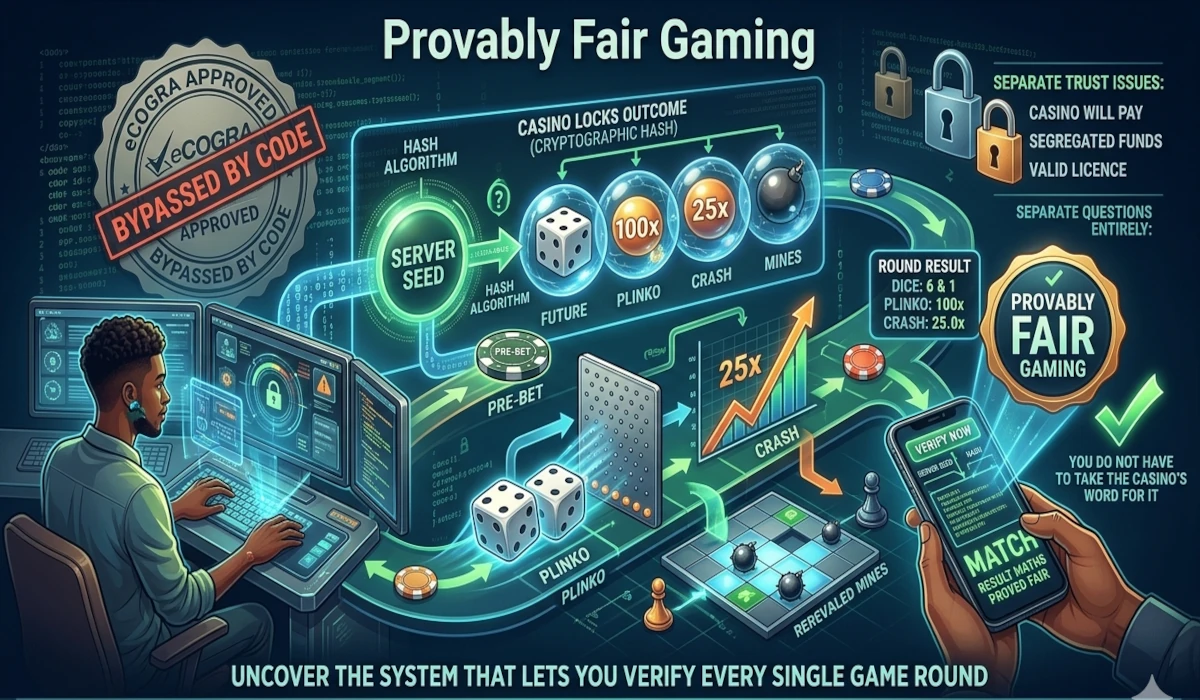
Before you place a bet, the casino locks in the game outcome using cryptographic code. You cannot see the outcome yet, but you can see proof that it was locked in before your bet.
After the round ends, the casino reveals the data, and you can verify that the result matches what was locked in. If it matches, the game was fair.
If it does not, the casino cheated, and you have the proof. The important distinction: you do not need to understand the cryptography to benefit from it.
The system works whether you verify every bet, spot-check occasionally, or never check at all. The fact that anyone can verify at any time is what keeps the casino honest.
🎮 Which Games Are Provably Fair
Provably fair only applies to games built natively by the casino or by providers who have specifically integrated the technology. These tend to be simpler, maths-driven game formats.
Games that commonly support provably fair include crash games (where a multiplier rises until it "crashes"), dice games (predicting whether a roll lands over or under a number), mines (revealing tiles on a grid without hitting a mine), Plinko (a ball dropping through pegs into multiplier slots), and some natively built card games like blackjack or hi-lo. Games that do not use provably fair include the vast majority of video slots.
Titles from game providers like Pragmatic Play, NetEnt, Play'n GO, Relax Gaming, and others use their own internal RNG systems, audited by third-party labs. These games are not provably fair in the cryptographic sense, but they are independently tested and certified.
BGaming is one of the few major providers that has implemented provably fair verification across a portion of its slot catalogue, making it an exception in the provider landscape. If a casino claims that all its games are provably fair, including third-party slots, treat that claim with scepticism.
The technology does not work that way.
⚖️ What Provably Fair Proves (and What It Does Not)
This is the most important section of this guide. Provably fair proves one thing: that the game outcome was determined before your bet and was not altered afterwards.
The maths were not rigged. It does not prove that the casino will process your withdrawal.
It does not prove that your funds are held in a segregated account. It does not prove that the casino holds a valid gambling licence.
It does not prove that the operator has the financial reserves to pay you if you win big. A casino can offer perfectly verifiable provably fair games and still refuse to pay you, change its bonus terms retroactively, or shut down overnight with player balances locked inside.
Provably fair is a game integrity tool. It is not a regulatory framework, and it is not a substitute for proper licensing, dispute resolution, or fund protection.
Those protections come from the licence the casino holds, which is why we review every operator against its regulatory obligations separately.
🔍 How to Check If a Casino Offers Provably Fair Games
You do not need to run cryptographic calculations. Look for these indicators.
Most provably fair games display a small shield icon, a "fairness" tab, or a "verify" button either within the game interface or in your bet history. Clicking it shows you the data from that round.
Some casinos also have a dedicated "Provably Fair" or "Fairness" page explaining how their system works and offering a built-in verification tool. If the casino claims to be provably fair but does not provide any in-game verification tool or transparency page, the claim is meaningless.
For players who want to go further, independent third-party verification tools exist online that let you paste in the round data and confirm the result independently, without relying on the casino's own tool. This is optional but adds an extra layer of confidence.
🆚 Provably Fair vs Traditional RNG: Which Is Better?
Neither is inherently better. They solve the same problem in different ways.
Traditional RNG relies on external auditors. The casino pays a lab to certify its games, and you trust the lab's reputation.
This model has worked for over two decades and is the standard at every major regulated casino. The downside is that you cannot independently verify a specific game round yourself.
Provably fair relies on open maths. You do not need to trust anyone because you can check the result directly.
The downside is that it only covers the game outcome, not anything else about how the casino operates. The strongest position for a player is a casino that offers provably fair games and holds a credible gambling licence with real enforcement behind it.
That combination gives you verifiable game integrity plus regulatory protections for everything else.
🌟 VistaGamble's Honest Assessment
We evaluated provably fair technology against the standards that actually matter to players: transparency, trustworthiness, and practical protection.
➕ The Positives
- Genuine transparency that no audit certificate can match: the ability to verify every single game round yourself is the highest standard of game fairness available in online gambling. No other system offers this level of player control.
- It keeps casinos honest by design: the fact that any player can check any round at any time means rigging a provably fair game is not just difficult, it is provably detectable. That accountability exists whether you personally verify or not.
- The technology is proven and widely adopted: provably fair has been in use since the early days of crypto gambling and is now standard across thousands of games at hundreds of casinos. It is not experimental.
➖ The Negatives
- It proves game fairness, nothing else: provably fair does not protect your funds, guarantee withdrawals, or provide dispute resolution. Players who treat it as a seal of overall trustworthiness are making a dangerous assumption.
- Most provably fair casinos operate under lighter regulatory frameworks: the majority sit under CGA, ABGB, or NOGA licences, where enforcement history and dispute resolution are weaker than at MGA or UKGC-licensed alternatives.
- It does not apply to most slots: if your primary interest is video slots from major providers, provably fair is irrelevant to your experience. Those games use traditional RNG auditing.
- Marketing misuse is common: some casinos use "provably fair" as a trust badge without providing actual verification tools, which misleads players into a false sense of security.
🔒 Conclusion
Provably fair is the strongest proof of game integrity available in online gambling. If you play crash games, dice, mines, or Plinko at crypto casinos, it gives you something no traditional casino can: the ability to prove, not just trust, that the result was fair.
It is not a replacement for a proper gambling licence, fund segregation, or dispute resolution. It answers one question and one question only: was this game round rigged?
If the answer matters to you, look for casinos that offer real verification tools, not just the label.
Frequently Asked Questions❓
What does provably fair mean?
It means the casino locks in the game result before you bet and gives you tools to verify nothing was changed afterwards. You can confirm the game was fair without trusting anyone.
Which games are provably fair?
Crash games, dice, mines, Plinko, and some natively built card games. Standard video slots from providers like Pragmatic Play or NetEnt use traditional RNG auditing instead.
Do I need to verify every bet?
No, the system works because verification is possible, not because every player does it. Spot-checking a few rounds is enough to confirm the system is functioning.
Does provably fair mean the casino is safe?
No, it proves the game maths were not rigged. It does not prove the casino will pay you, protect your funds, or operate under a credible licence.
How do I verify a provably fair game?
Look for a "fairness" or "verify" button in the game or your bet history, then click it to see the round data. For independent confirmation, paste the data into a third-party verification tool.
Are provably fair casinos better than traditional ones?
Not automatically, a provably fair casino with no licence and no fund segregation is riskier than a traditional casino regulated by the MGA or UKGC. The best option is a casino that offers both provably fair games and credible licensing.
 Popular Bonuses