



Blackjack Cheat Sheet | Essential Strategy Guide for Players
🗝️ Key Takeaways
- Use our blackjack cheat sheet to find the best play for every hand, from hard totals and soft totals to pairs.
- Learn to read the chart in seconds by matching your hand on the left with the dealer's upcard across the top.
- Discover when doubling down pays off, and how a $10 bet doubled to $20 returns $40 in total when it wins.
- See why basic strategy cuts the house edge to about 0.5%, and why no chart can ever give the player the edge.
- Check the table rules that change the house edge most, from soft 17 to 6:5 blackjack payouts.
- Learn when to split, which mistakes cost players most, and the key terms used at the table.
Every hand of blackjack asks the same question: hit, stand, double, split or surrender? A blackjack cheat sheet answers it for you, using the maths behind millions of simulated hands rather than gut feeling.
In this guide, we start with the full strategy chart, then walk through reading it, when to double down and split, how table rules change the edge, the mistakes to avoid and the key terms you will hear.
📋 The Blackjack Cheat Sheet
This chart follows basic strategy for games with 4 to 8 decks, where the dealer stands on soft 17, you can double after splitting and surrender is allowed. Find your hand in the left column, then read across to the dealer's upcard.
Key:
- H: Hit
- S: Stand
- D: Double if allowed, otherwise hit
- Ds: Double if allowed, otherwise stand
- P: Split
- Ph: Split if double after split is allowed, otherwise hit
- Rh: Surrender if allowed, otherwise hit
🔢 Hard Totals
A hard total is any hand without an ace, or with an ace that can only count as 1.
| Your hand | 2 | 3 | 4 | 5 | 6 | 7 | 8 | 9 | 10 | A |
| 8 or less | H | H | H | H | H | H | H | H | H | H |
| 9 | H | D | D | D | D | H | H | H | H | H |
| 10 | D | D | D | D | D | D | D | D | H | H |
| 11 | D | D | D | D | D | D | D | D | D | H |
| 12 | H | H | S | S | S | H | H | H | H | H |
| 13 | S | S | S | S | S | H | H | H | H | H |
| 14 | S | S | S | S | S | H | H | H | H | H |
| 15 | S | S | S | S | S | H | H | H | Rh | H |
| 16 | S | S | S | S | S | H | H | Rh | Rh | Rh |
| 17 or more | S | S | S | S | S | S | S | S | S | S |
🅰️ Soft Totals
A soft total is a hand with an ace that counts as 11 without taking you over 21.
| Your hand | 2 | 3 | 4 | 5 | 6 | 7 | 8 | 9 | 10 | A |
| A,2 (soft 13) | H | H | H | D | D | H | H | H | H | H |
| A,3 (soft 14) | H | H | H | D | D | H | H | H | H | H |
| A,4 (soft 15) | H | H | D | D | D | H | H | H | H | H |
| A,5 (soft 16) | H | H | D | D | D | H | H | H | H | H |
| A,6 (soft 17) | H | D | D | D | D | H | H | H | H | H |
| A,7 (soft 18) | S | Ds | Ds | Ds | Ds | S | S | H | H | H |
| A,8 or A,9 | S | S | S | S | S | S | S | S | S | S |
👯 Pairs
Use this table when your first two cards are the same rank and splitting is an option.
| Your pair | 2 | 3 | 4 | 5 | 6 | 7 | 8 | 9 | 10 | A |
| 2,2 | Ph | Ph | P | P | P | P | H | H | H | H |
| 3,3 | Ph | Ph | P | P | P | P | H | H | H | H |
| 4,4 | H | H | H | Ph | Ph | H | H | H | H | H |
| 5,5 | D | D | D | D | D | D | D | D | H | H |
| 6,6 | Ph | P | P | P | P | H | H | H | H | H |
| 7,7 | P | P | P | P | P | P | H | H | H | H |
| 8,8 | P | P | P | P | P | P | P | P | P | P |
| 9,9 | P | P | P | P | P | S | P | P | S | S |
| 10,10 | S | S | S | S | S | S | S | S | S | S |
| A,A | P | P | P | P | P | P | P | P | P | P |
📖 How to Read the Chart
Start by deciding which table your hand belongs to. Check the pairs table first if you hold a pair, use soft totals if you hold an ace that can count as 11, and use hard totals for everything else.
Next, find your hand in the left column and move across to the column for the dealer's upcard. The letter in that cell is your play.
Take a hard 16 against a dealer 10, where the chart shows Rh, so you surrender if the table allows it and hit if it does not. With a soft 17 (A-6) against a dealer 5, the chart shows D, so you double down.
If a play is not available at your table, follow the fallback in the key. Some games do not allow surrender or doubling after a split, which is exactly why those cells carry a second option.
⚙️ The Rule That Changes Most
The rule that varies most from casino to casino is whether the dealer hits or stands on soft 17. Our chart assumes the dealer stands, but when the dealer hits soft 17, a few plays change:
- Double 11 against a dealer ace.
- Double soft 18 (A-7) against a dealer 2.
- Double soft 19 (A-8) against a dealer 6.
- Surrender 15, a pair of 8s and hard 17 against a dealer ace, if surrender is allowed.
The rule is usually printed on the table felt or listed in the game's help screen online, so it takes seconds to check.
📉 What the Chart Can and Cannot Do
Basic strategy is the mathematically best way to play each hand, and it brings the house edge down to about 0.5% in a game with good rules. That is one of the lowest edges in any casino.
It never gives you the edge, though. The house stays about 0.5% ahead over the long run, so the chart helps your bankroll last longer rather than turning blackjack into a winning bet.
💰 When to Double Down
Doubling down means doubling your original bet in exchange for exactly one more card. It is the play that lets you put more money on the table when the odds lean your way.
Here is how the money works. You bet $10 and double to $20, so a win returns $40 in total, your $20 stake plus $20 profit, while a loss costs the full $20.
The chart tells you exactly when to double, but three spots come up most often:
- Hard 11: double against every dealer card except an ace.
- Hard 10: double against a dealer 2 to 9.
- Soft 17 (A-6): double against a dealer 3 to 6.
These plays work because of the ten-valued cards. Tens, jacks, queens and kings make up 16 of the 52 cards in each deck, so the next card is worth ten about 30.8% of the time, which gives a total of 10 or 11 a strong chance of reaching 20 or 21.
Soft hands are good doubling spots for a different reason. A soft hand cannot bust on the next card, because the ace can drop from 11 to 1, while a hard hand busts much more often when it takes a card.
🃏 When to Split
Splitting turns a pair into two separate hands, with a second bet equal to the first and each card starting a new hand. It is a strong play when it turns one weak hand into two better ones, and a costly one when it breaks up a hand that was already good.
Four rules cover the pairs that matter most:
- Always split aces: a pair of aces is only a soft 12, while each split ace has a good chance of drawing a ten-valued card. Most casinos give you just one more card on each split ace.
- Always split 8s: a pair of 8s makes 16, the weakest total in the game. Two hands starting on 8 do better over time than one 16, even against a dealer 10.
- Never split 10s: a total of 20 already wins most of the time, so breaking it up throws away a strong hand.
- Never split 5s: a pair of 5s is a hard 10, so play it as one and double down against a dealer 2 to 9.
The smaller pairs depend on the dealer's upcard. You split 2s, 3s, 6s and 7s when the dealer shows a weak card, roughly 2 to 6, because the dealer is more likely to bust there, and you hit when the dealer shows an 8 or higher.
9s surprise most players. You split them against a 2 to 6, 8 or 9, but stand against a 7, because your 18 already beats a likely dealer 17, and you also stand against a 10 or an ace.
Some cells in the pairs table are marked Ph. Those splits only pay if the casino lets you double after splitting, because part of their value comes from doubling a good total on one of the new hands, so without that rule, you hit.
📊 How Table Rules Change the House Edge
Our chart keeps the house edge at about 0.5%, but that figure depends on the rules at the table. The same strategy at a table with worse rules gives the casino a bigger edge, so the rules are worth checking before you sit down.
Here is how the most common rules change the house edge, using Wizard of Odds figures for an 8-deck game where the dealer stands on soft 17:
| Rule | Effect on the house edge |
| Blackjack pays 6:5 instead of 3:2 | +1.39% |
| Dealer hits soft 17 | +0.22% |
| No doubling after a split | +0.14% |
| Doubling only on 9, 10 or 11 | +0.09% |
| Late surrender allowed | -0.07% |
| 6 decks instead of 8 | -0.02% |
| Single deck instead of 8 | -0.48% |
The 6:5 payout matters far more than anything else. On a $10 bet, a blackjack pays $15 at a 3:2 table but only $12 at a 6:5 table, and over time that adds about 1.4% to the house edge, nearly triple the 0.5% you start with.
Fewer decks help the player a little, but some single-deck games pay only 6:5 for a blackjack, which more than cancels the gain. A shoe game with 3:2 payouts, where the dealer stands on soft 17, is usually the better choice.
📚 Blackjack Glossary
These are the terms you will see on the chart and hear at the table.
- Upcard: the dealer's face-up card, which decides the column you read on the chart.
- Hard hand: any hand where an ace, if there is one, has to count as 1.
- Soft hand: one where an ace is valued at 11, for example A-6, known as soft 17.
- Hit: take another card.
- Stand: keep your total and end your turn.
- Double down: double your bet and take exactly one more card.
- Split: turn a pair into two separate hands, each with its own bet.
- Surrender: give up the hand and get half your bet back, where the table allows it.
- Bust: go over 21 and lose the hand.
- Blackjack: an ace and a ten-valued card as your first two cards.
- Push: a tie with the dealer, where your bet is returned.
- Insurance: a side bet offered when the dealer shows an ace, paying if the dealer has blackjack.
- Shoe: the box that holds several decks at multi-deck tables.
- H17 and S17: short for "dealer hits soft 17" and "dealer stands on soft 17".
For a closer look at how each card counts, see our breakdown of blackjack card values.
❌ Mistakes That Cost Blackjack Players
These errors are common, and each one hands back part of the edge the chart saves you.
- Copying the dealer: hitting until 17 every time ignores the dealer's upcard and gives the house a far bigger edge than basic strategy does.
- Never risking a bust: standing on 12 to 16 against a 7 or higher feels safe, but the dealer will often reach 17 or more, so you lose more hands than you save.
- Standing on soft 17: with A-6, one more card cannot bust you, so standing wastes a free chance to improve. Hit or double, as the chart shows.
- Keeping 8s together against a 10: it feels like adding a second bet to a losing spot, but two hands starting on 8 lose less over time than one 16.
- Chasing a streak: a run of losses does not mean a win is due. Stick to the chart and your budget rather than changing plays or raising bets to win money back.
🎯 Table Tips
- Check the rules first: look for whether the dealer hits soft 17, whether surrender is offered and whether blackjack pays 3:2, since 6:5 tables cost you more.
- Skip insurance: basic strategy never takes insurance or even money, as the side bet favours the house.
- Use the chart openly: most casinos are happy for players to follow a strategy card, as long as it does not slow the game.
- Practise for free: learn the chart in a demo game before you stake real money, so the plays become automatic.
- Set a budget: decide what you are happy to spend before you sit down, and stop when you reach it.
Want to put these tips into practice? Our online blackjack page lists casinos where you can play.
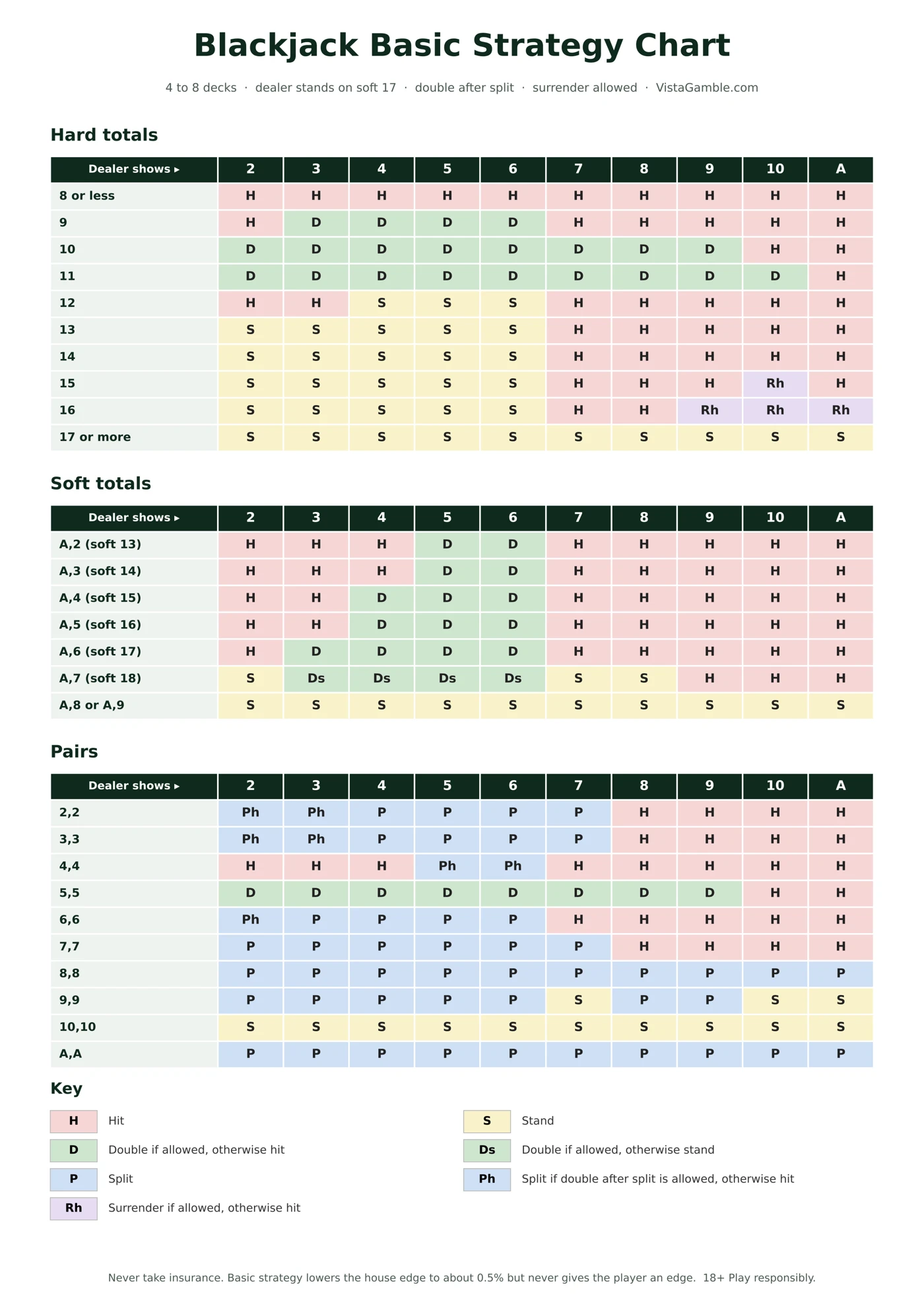
🖼️ The Full Chart at a Glance
Here is the whole cheat sheet in one image, with all three tables and the key together, using exactly the same plays as the charts above.
🌟 VistaGamble's Honest Assessment
A blackjack cheat sheet earns its place in any player's toolkit, as long as you are clear about what it does. Here is where it helps and where it falls short.
➕ The Positives
- One of the lowest house edges around: perfect basic strategy keeps the casino's advantage at about 0.5% in good games.
- No guesswork: every hand has one clear answer, which takes the stress out of tough spots like 16 against a 10.
- Allowed at most tables: casinos generally accept strategy cards, so you can learn as you play.
➖ The Negatives
- No player edge: the chart reduces losses over time, but the house always keeps its advantage.
- Rules change the plays: a chart built for one set of rules needs small adjustments at tables where the dealer hits soft 17.
- Short-term swings remain: even perfect play can lose several hands in a row, because each result still depends on the cards.
🔒 Conclusion
A blackjack cheat sheet turns every decision into a quick lookup. Locate your hand, line it up with the dealer's upcard, and you are making the best play the maths allows.
Check whether the dealer hits soft 17, keep our chart handy while you learn, and remember that basic strategy keeps the house edge low rather than removing it.
Frequently Asked Questions❓
What is a blackjack cheat sheet?
It is a basic strategy chart that shows the right move for each of your hands against each dealer upcard. It covers hard totals, soft totals and pairs.
Is it legal to use a blackjack cheat sheet in a casino?
Yes, using a strategy chart is legal, and most casinos allow it at the table. Just use it quickly so you do not slow the game down.
Does a blackjack cheat sheet guarantee wins?
No, it lowers the house edge to about 0.5% but never gives you the advantage. Individual sessions can still go either way.
When should you double down in blackjack?
The most common spots are hard 11 against anything but an ace, hard 10 against a 2 to 9 and soft 17 against a 3 to 6. Our chart shows every doubling play.
When should you split in blackjack?
Always split aces and 8s, and never split 10s or 5s. The other pairs depend on the dealer's upcard, as shown in our pairs table.
Should you hit 16 against a dealer 10?
Yes, hit 16 against a 10 unless the table offers surrender. If surrender is allowed, giving up half your bet is the better play.
What does it mean if the dealer hits soft 17?
It means the dealer must take another card when holding an ace and a six. This rule varies between casinos and changes a few plays on the chart.