


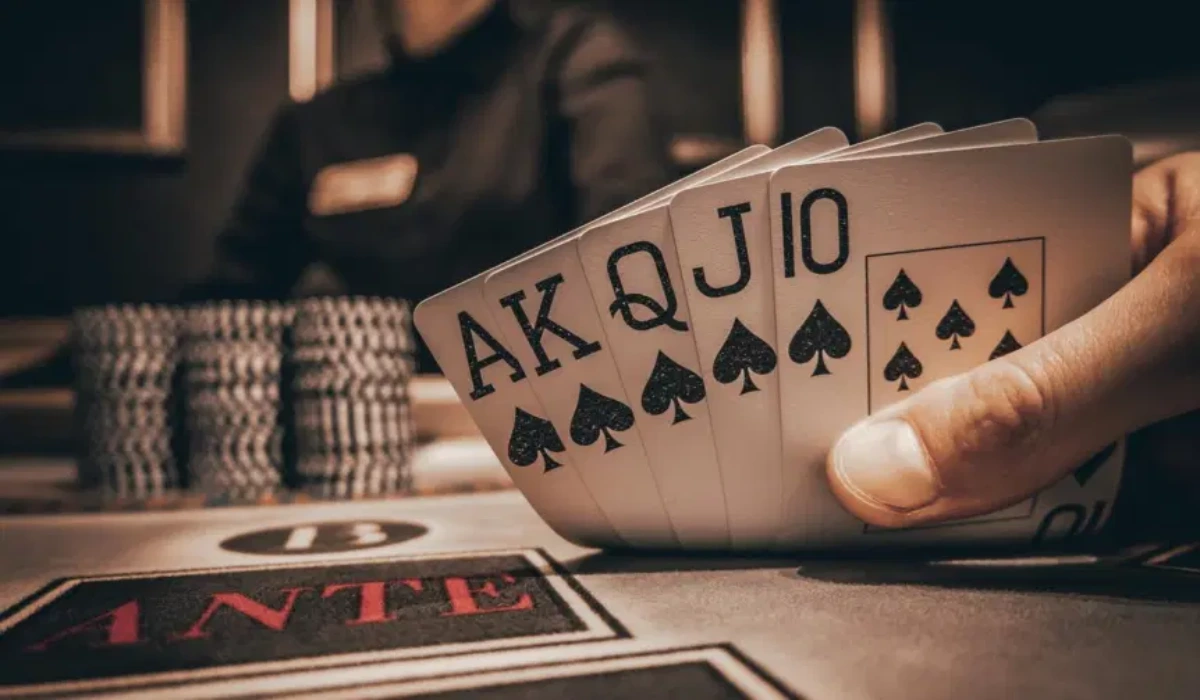

Poker Hand Rankings Explained | From Highest to Lowest
🗝️ Key Takeaways
- Learn the ten poker hands in order, from the royal flush at the top down to high card, with a clear example of each.
- See why a straight flush beats four of a kind and a straight beats three of a kind, two match-ups that regularly catch new players out.
- Find out how rare each hand really is, from 1 in 649,740 for a royal flush to roughly every other deal for a plain high card.
- Understand how ties are settled with kickers, and why the suit of a card never decides who wins the pot.
- Use the example hand in every section as a quick visual check while the rankings become second nature.
- Discover how lowball games such as Razz and deuce-to-seven, along with Short Deck, turn parts of the order upside down.
Every poker game, from a kitchen-table session to a high-stakes final table, comes down to the same question at showdown: whose five cards are best? Get the hand rankings wrong and you can fold a winner or pay off a loser without ever realising it.
In this guide, we walk you through all ten hands from highest to lowest, show you how often each one turns up, and explain how ties are broken. You will also find a quick look at the variants that change the rules and the mistakes that catch new players out.
💡 How Poker Hands Are Ranked
A poker hand is always made of exactly five cards. In games like Texas Hold'em and Omaha you see more than five, but only your best five-card combination counts at showdown.
The ten hand types form a fixed ladder, and any hand on a higher rung beats every hand below it. The rarer a hand is, the higher it ranks, which is why a royal flush sits at the top and a high card sits at the bottom.
Suits carry no value in standard poker. A flush in spades is worth exactly the same as a flush in hearts, so when two players hold the same hand, the ranks of the cards decide the winner and an exact match splits the pot.
The ace is the one flexible card. It plays high in an A-K-Q-J-10 straight and low in a 5-4-3-2-A straight, known as the wheel, but a straight can never wrap around the corner, so Q-K-A-2-3 is not a straight.
🏆 The Ten Poker Hands From Highest to Lowest
Here is the full order, starting with the hand every player dreams of and finishing with the one you will see most often.
1. Royal Flush
Example: A♣ K♣ Q♣ J♣ 10♣
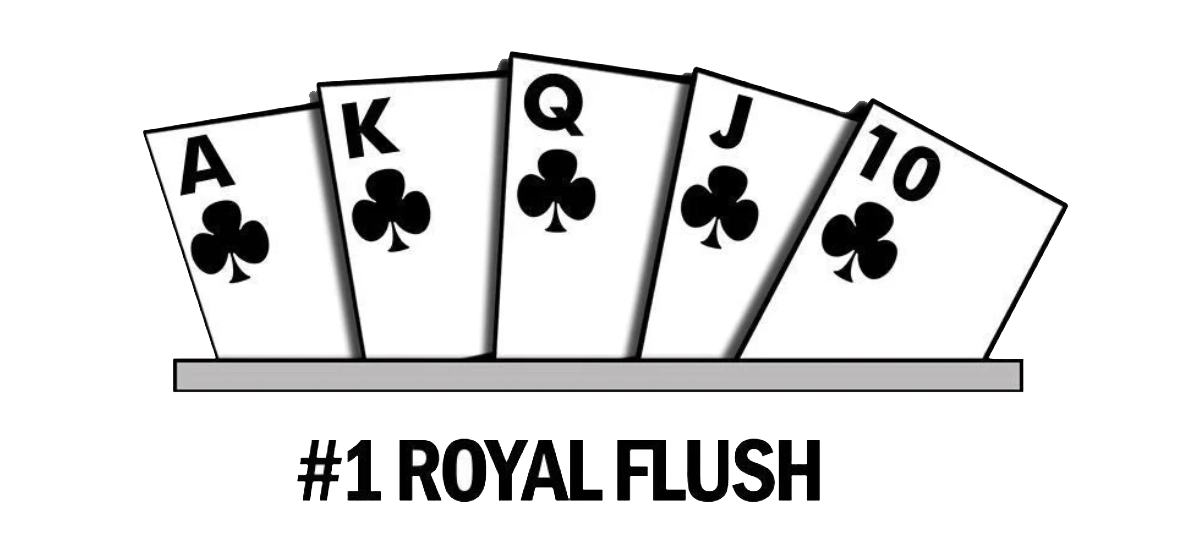
A royal flush is the ace-high straight flush: ace, king, queen, jack and ten, all in the same suit. Only four exist in the whole deck, one for each suit, so it cannot be beaten in standard poker.
Out of 2,598,960 possible five-card hands, just 1 in 649,740 is a royal flush. Plenty of regular players go years without ever holding one.
2. Straight Flush
Example: 9♦ 8♦ 7♦ 6♦ 5♦
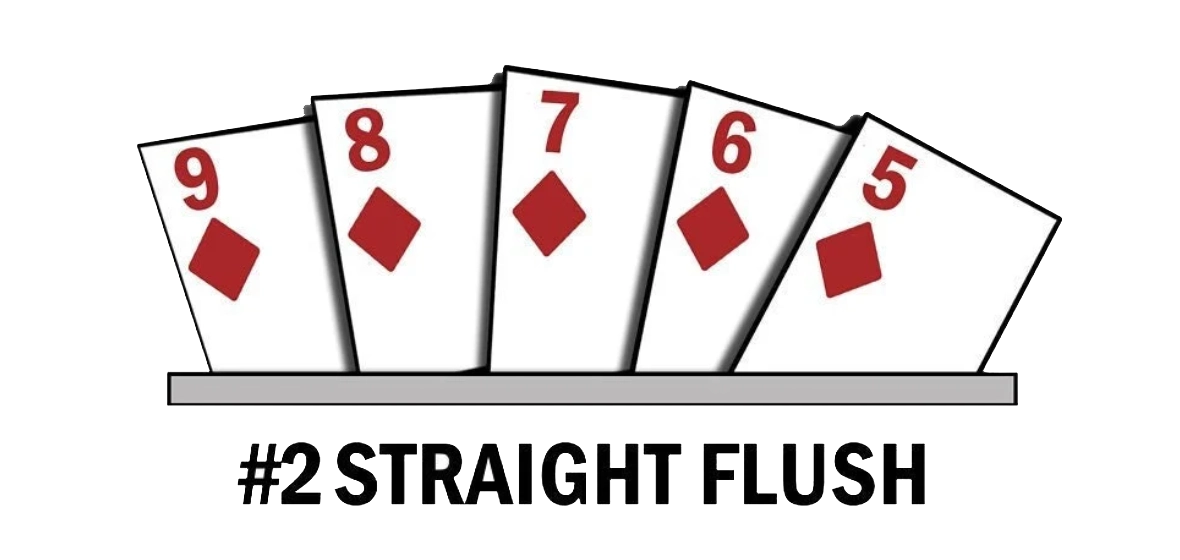
A straight flush is five cards in sequence, all of the same suit. It beats four of a kind, even though both hands are extremely rare.
When two straight flushes meet, the one with the higher top card wins. The lowest possible straight flush is 5-4-3-2-A of one suit, with the ace playing low.
3. Four of a Kind
Example: A♥ A♠ A♦ A♣ 9♥
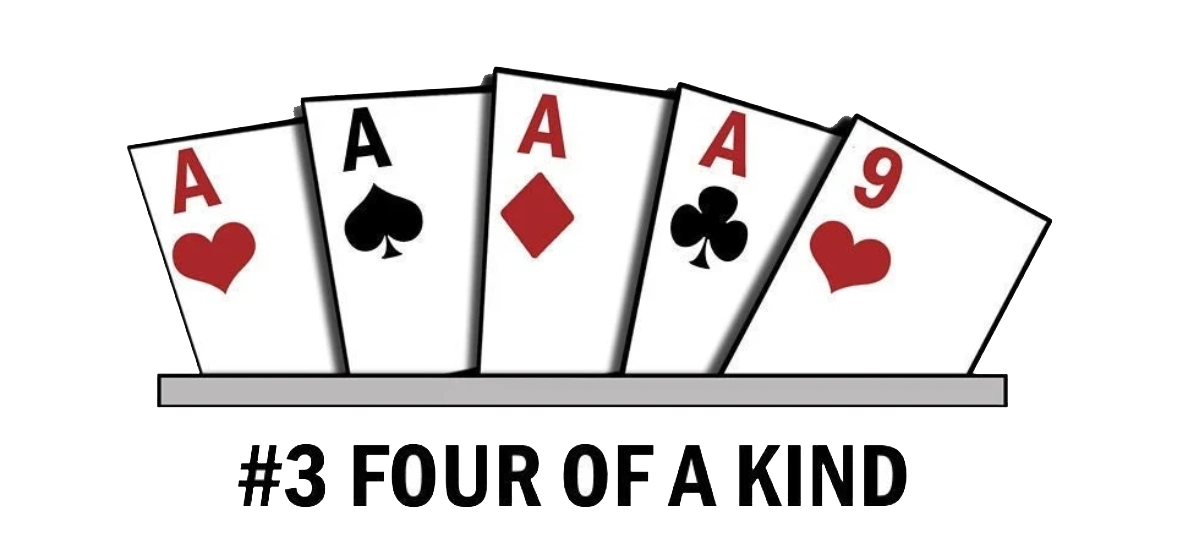
Four of a kind, often called quads, is all four cards of one rank plus any fifth card. The hand above is four aces with a nine kicker, and higher quads always beat lower quads.
In community card games two players can share the same quads on the board. In that case the fifth card, the kicker, settles the pot.
4. Full House
Example: K♦ K♣ K♥ A♥ A♠
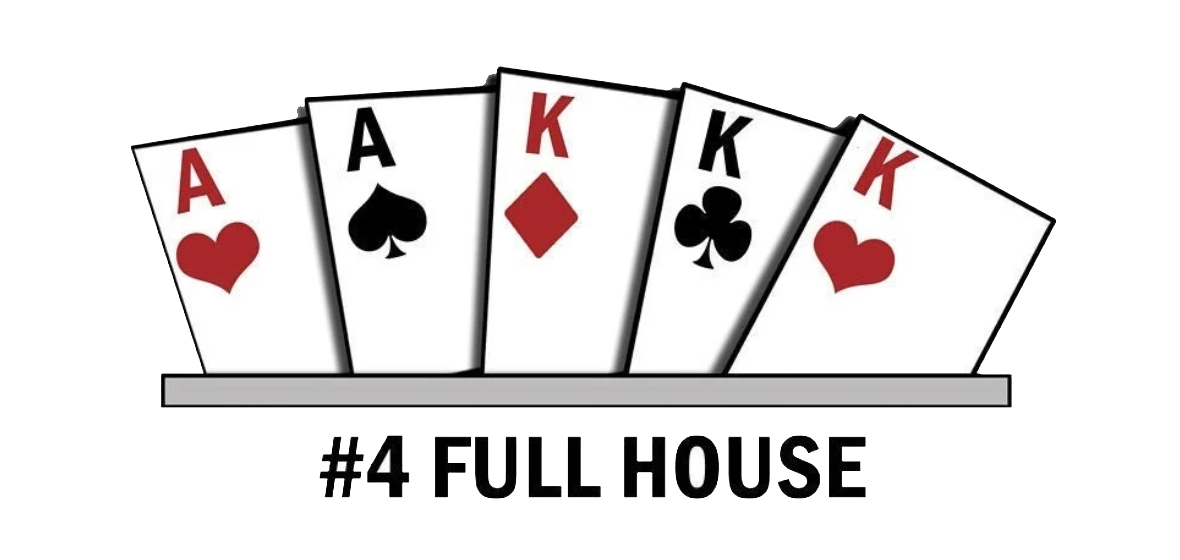
A full house combines three of a kind with a pair. The hand above is described as kings full of aces.
The three matching cards are compared first, so queens full of twos beats jacks full of aces. Only if the trips are equal does the pair come into play.
5. Flush
Example: A♠ K♠ 9♠ 6♠ 3♠
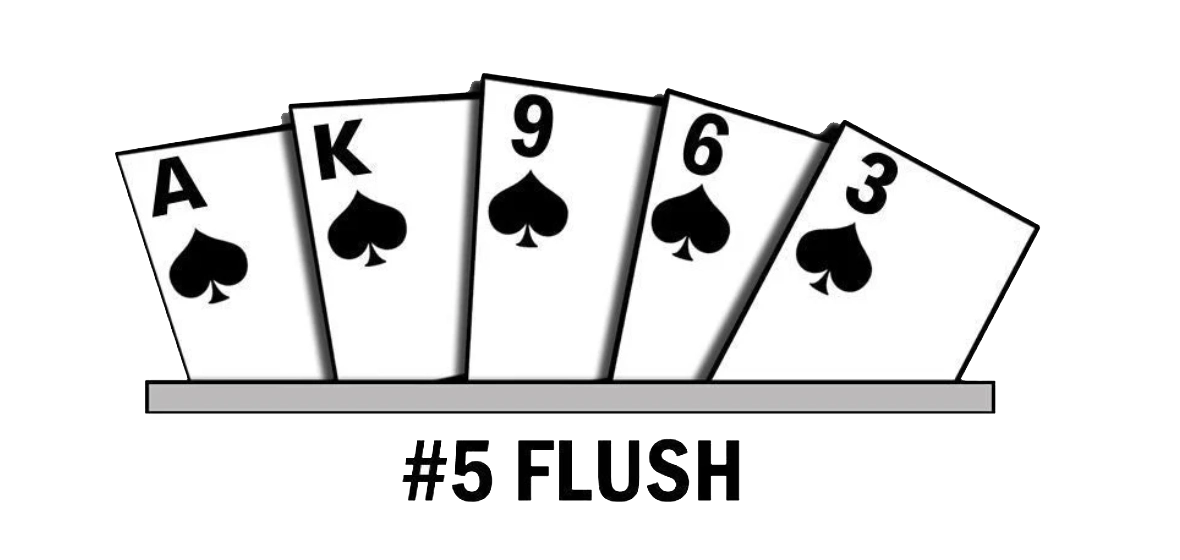
A flush is any five cards of the same suit that are not in sequence. Two flushes are compared card by card from the top down, so an ace-high flush beats a king-high flush.
A flush turns up in roughly 1 in 509 five-card hands, which works out at odds of about 508 to 1 against.
6. Straight
Example: 5♥ 4♠ 3♦ 2♣ A♥
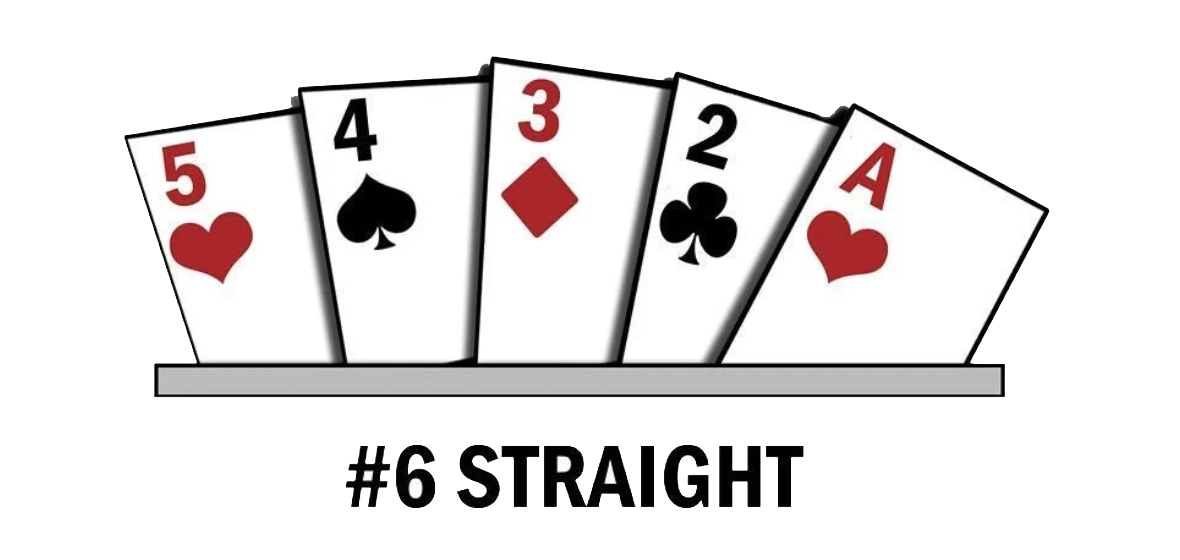
A straight is five cards in a row in mixed suits. It beats three of a kind, a point that surprises many beginners who assume trips must be stronger.
The hand above is the wheel, 5-4-3-2-A, the lowest straight possible, while the highest runs from ace down to ten. Between two straights, the straight that ends on the higher card takes the pot.
7. Three of a Kind
Example: 9♦ 9♣ 9♥ 6♥ 3♠
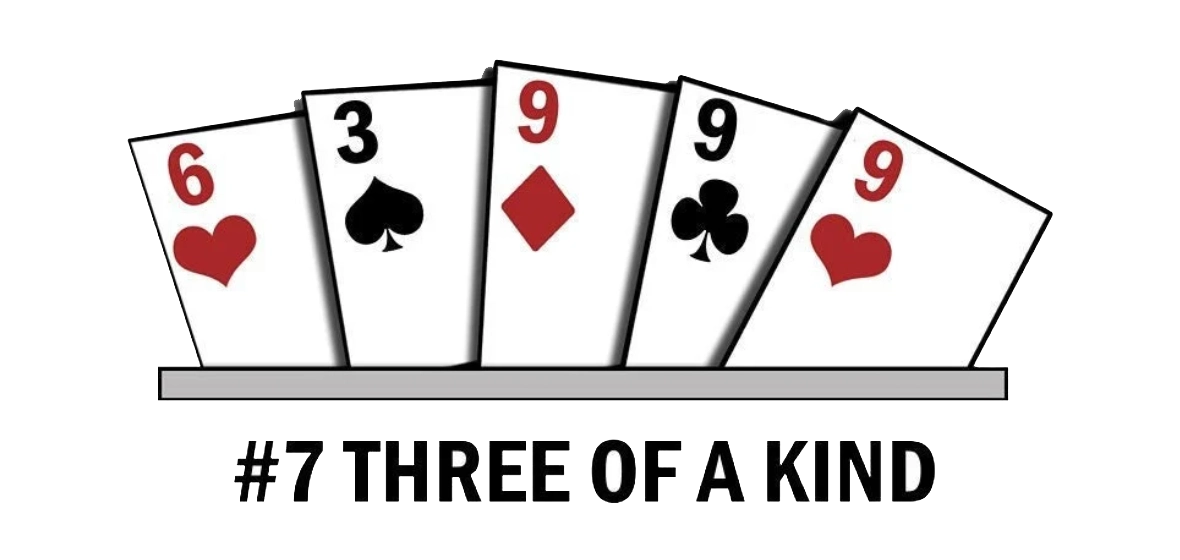
Three of a kind is three cards of the same rank alongside two unrelated cards. In Hold'em, players call it a set when you hold a pocket pair and hit the third card on the board, and trips when two of the cards are on the board.
The hand above is three nines with a six and a three alongside. Higher trips always win, and if both players share the same three cards, the kickers decide it.
8. Two Pair
Example: A♥ A♠ K♦ K♣ 4♥
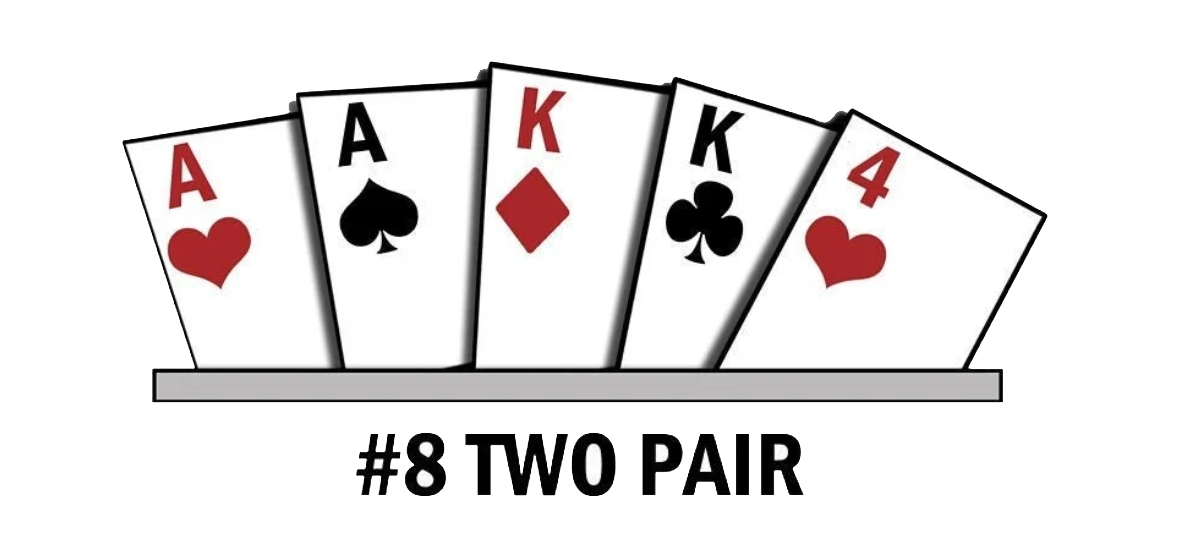
Two pair is exactly what it sounds like: two separate pairs plus a fifth card. The hand above is aces and kings with a four kicker.
The higher pair is compared first, then the lower pair, then the kicker. That is why kings and twos beat queens and jacks.
9. Pair
Example: 9♣ 9♥ 7♦ 6♥ 3♠
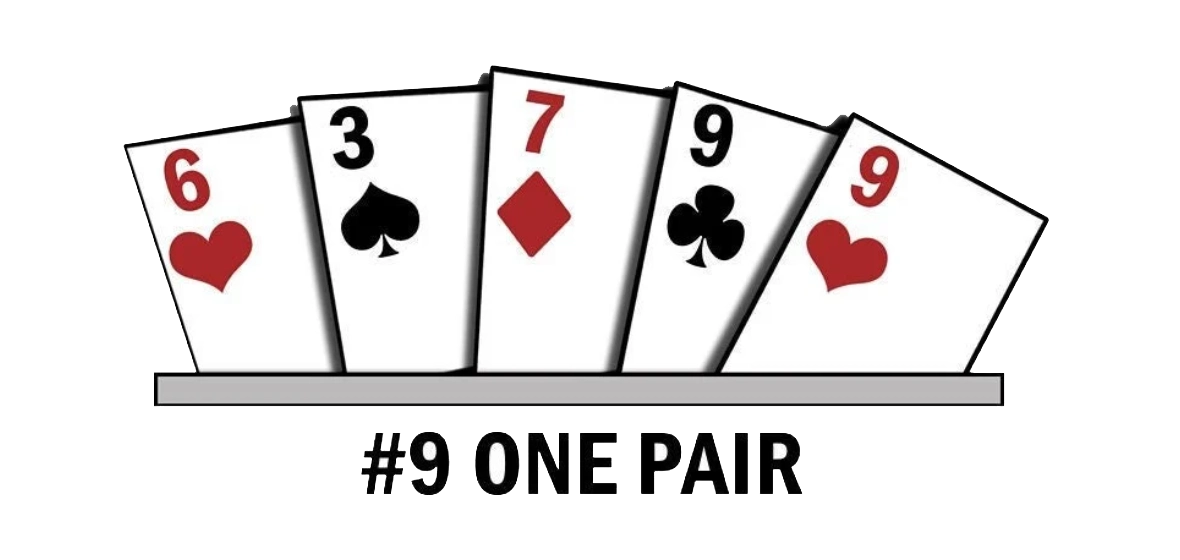
A pair is two cards of the same rank with three unmatched cards, like the pair of nines above. It is the most common made hand in poker and often good enough to win small pots.
If both players have the same pair, the highest side card wins, followed by the next, and so on down the line.
10. High Card
Example: A♥ 7♠ 5♥ 3♦ 2♣
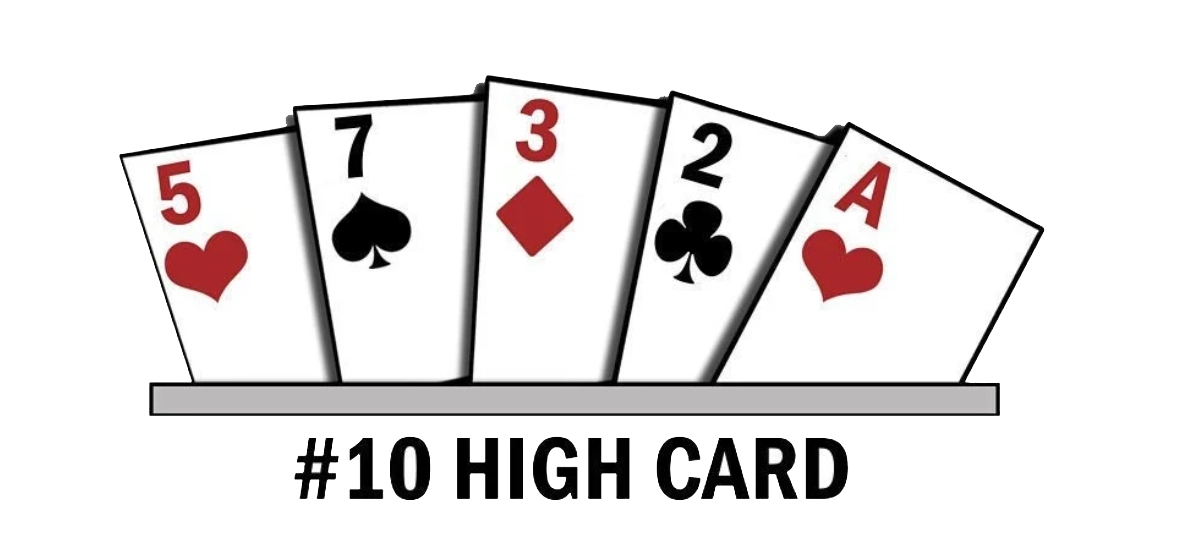
High card is any hand that makes none of the combinations above. It is valued by its top card, so the example is called ace high.
If two players both hold ace high, the second card decides, then the third, until one hand comes out ahead or the pot is split.
📊 How Often Each Hand Comes Up
The table below shows how often each hand appears in a five-card deal and as the best hand from seven cards, as in Texas Hold'em or seven-card stud. In total there are 2,598,960 distinct five-card hands and 133,784,560 ways to receive seven cards.
| Hand | 5-card combinations | 5 cards: 1 in | 7 cards: chance |
| Royal flush | 4 | 649,740 | 0.0032% |
| Straight flush | 36 | 72,193 | 0.0279% |
| Four of a kind | 624 | 4,165 | 0.168% |
| Full house | 3,744 | 694 | 2.60% |
| Flush | 5,108 | 509 | 3.03% |
| Straight | 10,200 | 255 | 4.62% |
| Three of a kind | 54,912 | 47 | 4.83% |
| Two pair | 123,552 | 21 | 23.5% |
| Pair | 1,098,240 | 2.4 | 43.8% |
| High card | 1,302,540 | 2.0 | 17.4% |
The seven-card column holds one surprise. With seven cards to choose from, you are more likely to finish with two pair than with nothing at all, which is why high card drops sharply compared with a five-card deal.
🔄 Lowball and Short Deck: How the Order Changes
A few popular variants bend the standard ladder, so it pays to know the house rules before you sit down.
Razz is a seven-card stud game where the lowest hand wins. Aces always count low, straights and flushes are ignored, and the best possible hand is A-2-3-4-5.
Deuce-to-seven lowball also rewards the lowest hand, but here aces count high and straights and flushes count against you. That makes 2-3-4-5-7 in mixed suits the best hand you can hold.
Short Deck, also known as Six Plus Hold'em, removes the twos through fives and plays with 36 cards. With fewer cards of each suit, flushes become harder to make, so a flush beats a full house, though some rooms change other parts of the order too, so always check the table's rule sheet.
⚠️ Common Mistakes to Avoid
- Ranking the suits: suits never break ties in standard poker, so equal hands split the pot.
- Wrapping a straight: the ace can play high or low, but K-A-2-3-4 is not a straight.
- Counting more than five cards: only your best five cards play, so a sixth or seventh card can never act as an extra kicker.
- Forgetting the board: in Hold'em the best five cards may all be on the table, in which case every remaining player shares the pot.
🌟 VistaGamble's Honest Assessment
Learning the hand rankings is the best place to start in poker, but it is only the foundation. Here is what the standard ladder does well and where it can trip you up.
➕ The Positives
- One order for most games: the same ten hands apply across Texas Hold'em, Omaha, five-card draw and seven-card stud.
- Quick to learn: the ladder follows rarity, so a few minutes with the examples above is enough to get the basics down.
- Clear tie-breaks: card ranks and kickers settle almost every showdown, with an exact match simply splitting the pot.
➖ The Negatives
- Variants change the rules: lowball games and Short Deck rewrite parts of the order, which catches out players who switch tables.
- Kickers confuse beginners: deciding which side cards count, especially with shared board cards, takes practice.
- Rankings alone are not enough: knowing which hand wins won't show you how to bet it, so expect a learning curve beyond the order itself.
🔒 Conclusion
Poker hand rankings run from the royal flush down to high card, and that order holds in nearly every game you will meet. Remember that a straight flush beats four of a kind, a straight beats three of a kind and suits never matter, and you are ahead of most new players.
Keep this page bookmarked for your first few sessions, grab our poker cheat sheet for beginners for more quick tips, and check the house rules whenever you try a lowball or Short Deck table.
Frequently Asked Questions❓
What is the highest hand in poker?
The royal flush is the highest hand, made of A-K-Q-J-10 all in one suit. You can expect one roughly every 649,740 five-card deals.
Does a flush beat a straight?
Yes, a flush ranks above a straight in standard poker. A straight in turn beats three of a kind.
Does a straight flush beat four of a kind?
Yes, a straight flush beats four of a kind. Only a royal flush, which is the highest straight flush, ranks above it.
What happens if two players have the same hand?
The higher-ranked cards within the hand decide the winner first, and the kickers come next. If all five cards match in rank, the pot is split.
Do suits matter in poker hand rankings?
No, all four suits are equal in standard poker. A spade flush and a heart flush with the same ranks tie.
Why does a flush beat a full house in Short Deck?
Short Deck strips out every two, three, four and five, leaving only nine cards of each suit. That makes flushes rarer than full houses, so the flush moves above it.